 Reviews



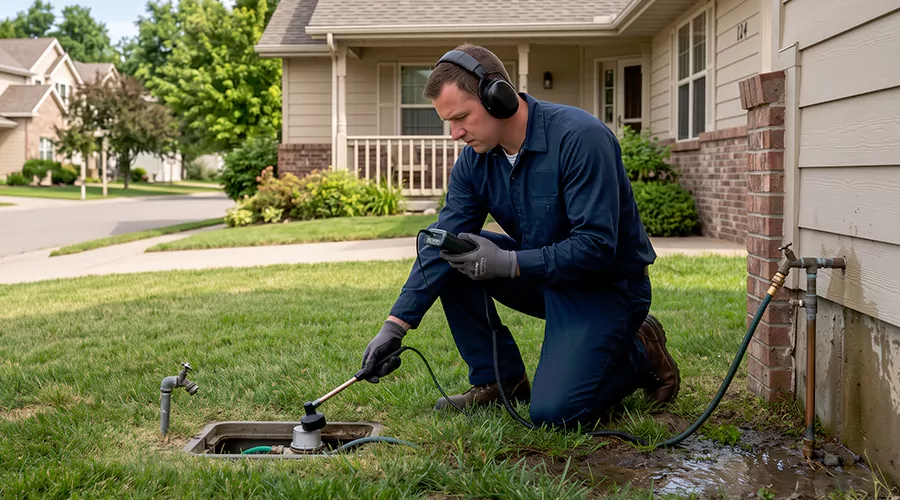
Water leak detection finds hidden leaks by measuring evidence that escaping water creates, such as unusual flow or leak noise. Other methods identify moisture or temperature differences at accessible surfaces. Professionals often combine several tests because no single device can locate every type of leak.
Professional water leak detection generally costs 100–500 in the United States in 2026. The process is usually non-destructive at first. Instead of opening walls immediately, the technician narrows the suspected area and verifies the evidence before deciding where access is required.
What Is Water Leak Detection?
Water leak detection is the process of confirming that unintended water flow exists and narrowing its source. The method depends on whether the leak comes from pressurized plumbing or moisture entering from another source. The goal is to reduce unnecessary demolition while collecting enough evidence to plan a repair.
Common leak-detection methods include:
- Water-meter testing.
- Flow monitoring.
- Acoustic listening.
- Leak-noise correlation.
- Thermal imaging.
- Moisture measurement.
- Pressure testing.
- Visual inspection.
EPA WaterSense separates residential leak detection into two broad categories. Moisture sensors detect unexpected dampness, while flow-monitoring devices measure water movement and identify patterns that suggest a leak.
Professional diagnosis can then use more targeted tools to narrow the physical location.
How Does the Water Meter Help Find a Hidden Leak?
The water meter confirms whether water is moving through the property's supply while known fixtures are inactive. It is one of the simplest ways to test for a hidden pressurized leak. However, it cannot identify whether the water is escaping beneath the slab or inside a wall.
EPA WaterSense recommends this test:
- Turn off faucets.
- Wait until toilets stop refilling.
- Stop water-using appliances.
- Disable irrigation.
- Record the meter reading.
- Use no water for two hours.
- Read the meter again.
- Compare the readings.
A change means water probably moved somewhere during the test.
The next step is eliminating ordinary fixture leaks before investigating concealed piping.
How Does Acoustic Leak Detection Work?
Acoustic leak detection listens for vibration produced when pressurized water escapes through an opening in a pipe. Sensitive microphones or contact sensors amplify the sound. A technician compares readings at different locations to narrow the area where the leak is strongest. The U.S. Department of Energy explains that escaping pressurized water produces distinctive noise. Noise loggers can record those sounds while leak correlators compare signals from two points on a pipe. The method works particularly well on pressurized plumbing. It is less useful for a gravity drainage leak that produces little continuous pressure noise.
What Is a Leak Noise Correlator?
A leak correlator uses two sensors placed at separate access points on the same pipe. Water escaping between the sensors produces noise that reaches each sensor at a slightly different time. The equipment uses this time difference with pipe information to calculate the likely leak position.
The process typically works like this:
- A suspected pipe run is identified.
- Sensors are attached at two accessible locations.
- The equipment records the leak noise.
- The arrival-time difference is measured.
- Pipe material and diameter are entered.
- The system estimates the leak's position.
- Ground listening can refine the final location.
The U.S. Department of Energy explains that correlators use the sound-arrival time difference along with pipe material and diameter to calculate leak position. The Hong Kong Water Supplies Department describes the same process as part of municipal leak detection.
Does Acoustic Detection Work on Every Pipe?
Acoustic performance depends on pipe material and background conditions. Metal pipes generally transmit leak noise more effectively than many plastic materials. Low water pressure or heavy background noise can also reduce the clarity of the signal.
The department of energy notes that acoustic loggers work well on cast iron and steel. PVC can require longer recording periods or closer sensor spacing.
Other factors include:
- Pipe diameter.
- Water pressure.
- Soil conditions.
- Depth.
- Nearby machinery.
- Traffic noise.
- Multiple branches.
This is one reason professionals may combine acoustic testing with another method.
How Does Thermal Imaging Find Water Leaks?
Thermal imaging identifies surface temperature differences that can be associated with hidden moisture or leaking hot-water pipes. The camera does not see through walls or concrete. Instead, it maps infrared radiation from the surface in front of it. A hidden water leak can alter surface temperature through heat transfer or evaporation. The resulting thermal pattern can guide further testing. FLIR explains that thermal cameras can help locate moisture patterns but cannot directly detect water through building materials. For example, a hot-water slab leak may create a warmer area on the floor. A roof leak may produce a cooler evaporation pattern on drywall. The temperature pattern still needs confirmation.
Why Does Thermal Imaging Need Verification?
A thermal camera can show a temperature difference without proving that water caused it. Insulation gaps or air movement can create similar patterns. Sun exposure and HVAC ducts can also affect temperatures. FLIR recommends confirming suspicious thermal patterns with a moisture meter. This prevents unnecessary wall opening based solely on an infrared image.
A useful detection process might therefore involve:
- Identifying an unusual thermal pattern.
- Comparing surrounding temperatures.
- Testing the area with a moisture meter.
- Checking water-flow evidence.
- Inspecting nearby plumbing routes.
- Confirming the likely source before access.
The strongest diagnosis comes from several forms of evidence pointing toward the same area.
How Does a Moisture Meter Find Hidden Water?
A moisture meter measures moisture in or near building materials to confirm that an area is wetter than expected. It is particularly useful after a thermal camera identifies a suspicious pattern. Some meters use pins while others detect moisture without penetrating the surface.
Moisture readings can help determine:
- Whether drywall is damp.
- How far moisture has spread.
- Whether flooring contains excess moisture.
- Whether a thermal pattern corresponds with actual dampness.
- Whether drying is progressing after a repair.
A moisture meter does not necessarily identify the leaking pipe. It identifies where moisture has reached the building material. Water can travel away from its original source before becoming visible.
How Does Pressure Testing Find Plumbing Leaks?
Pressure testing helps determine whether a closed section of piping can hold pressure without an unexplained drop. It is particularly useful when visible inspection cannot confirm the integrity of concealed plumbing. WaterSense construction verification also uses pressure-loss testing to confirm that water-supply systems are free of leaks.
- A professional pressure test typically isolates a plumbing section.
- The technician then monitors whether the test pressure remains stable.
- A pressure loss can indicate that the isolated section is not watertight.
- The test still does not reveal the exact hole location.
- Acoustic or other locating methods may be needed afterward.
How Do Flow Monitoring Devices Detect Leaks?
Flow monitors detect unexpected water movement or consumption patterns rather than locating a physical hole directly. Some devices learn normal household usage. They can alert the homeowner when flow continues for an unusual period or occurs when little water use is expected. EPA WaterSense explains that flow-monitoring devices measure how much water is flowing and look for consumption patterns associated with leakage or another irregular condition.
- Some systems can also close a valve automatically.
- That function can reduce water loss after a major event.
- However, a flow alarm does not tell you automatically which pipe or fixture is leaking.
What Is the Difference Between Detection and Location?
Detecting a leak means establishing that unintended water loss exists. Locating the leak means narrowing the physical point where water is escaping. These are related tasks, but they may use different tools.
| Method | Confirms Leak? | Helps Locate Leak? | Main Limitation |
|---|---|---|---|
| Water meter | Yes | No | Shows total unexplained use |
| Flow monitor | Yes | Sometimes by zone | Does not see pipe damage |
| Acoustic listening | Yes | Yes | Needs useful leak noise |
| Correlator | Yes | Yes | Requires suitable access and pipe data |
| Thermal imaging | Indirectly | Yes | Detects surface temperature patterns |
| Moisture meter | Confirms dampness | Helps define wet area | Water can travel from source |
| Pressure test | Yes for isolated piping | Narrows system section | Does not pinpoint exact hole |
| Visual inspection | Sometimes | Yes when leak is exposed | Concealed leaks remain hidden |
Professionals often begin with broad confirmation and move toward more precise location methods. This reduces unnecessary destructive access.
How Is a Hidden Leak Behind a Wall Found?
A hidden wall leak is normally narrowed using moisture evidence and plumbing layout before the wall is opened. Surface staining can identify the general area. Thermal imaging or a moisture meter can then help define the affected section.
A typical investigation may include:
- Confirming unexplained water use.
- Inspecting visible fixtures nearby.
- Identifying supply and drain routes.
- Scanning the wall for thermal differences.
- Checking moisture levels.
- Listening for pressurized leak noise.
- Isolating plumbing sections when needed.
- Opening only the area supported by the evidence.
This process does not guarantee zero wall damage. The goal is to avoid opening large areas without evidence.
How Is a Slab Leak Detected?
Slab leak detection combines tests because the pipe is hidden beneath concrete. Meter testing can establish unexplained water loss. Acoustic equipment can listen for escaping pressurized water, while thermal imaging can identify temperature patterns created by a hot-water leak.
Angi reports that slab leak professionals commonly use acoustic equipment and thermal imaging before selecting a repair location.
A slab investigation may involve:
- Meter testing.
- Pressure isolation.
- Acoustic listening.
- Correlation.
- Thermal scanning.
- Pipe route tracing.
The exact process depends on whether the buried pipe carries hot water or cold water.
Can Leak Detection Find Underground Yard Leaks?
Underground pressurized water leaks can often be located by combining meter evidence with acoustic testing along the buried pipe route. Escaping water may create wet soil or reduced pressure. However, not every buried leak reaches the ground surface.
The department of energy notes that leak-noise equipment can be attached to valves or other accessible points along buried water distribution piping.
Possible signs include:
- Unexplained meter movement.
- Wet ground during dry weather.
- Reduced water pressure.
- Soil erosion.
- Water pooling without rainfall.
Irrigation problems should also be ruled out.
How Accurate Is Water Leak Detection?
There is no single accuracy percentage that applies to every leak-detection job. Results depend on pipe material and leak size. Access and background noise also matter. A method that works well for one pressurized copper line may provide limited information on a gravity drain. The best approach is confirmation.
For example:
- Acoustic equipment identifies a likely location.
- Thermal imaging finds a matching surface pattern.
- Moisture testing confirms dampness.
- Pressure testing shows that the pipe section loses pressure.
Agreement between several methods increases confidence before destructive access begins.
How Much Does Water Leak Detection Cost in 2026?
Professional water leak detection generally costs 100–500 in the United States in 2026. More specialized slab leak detection typically costs 150–400 and averages around $280.
| Detection Service | 2026 U.S. Cost Reference |
|---|---|
| General professional leak detection | 100–500 |
| Slab leak detection | 150–400 |
| Average slab leak detection | $280 |
| Complete slab leak repair | 630–4,400 |
Detection and repair are separate services. Finding the leak does not automatically include replacing the damaged pipe or restoring walls and flooring.
When Should You Call a Professional?
Professional leak detection becomes useful when water use indicates a leak but accessible fixtures are dry. Hidden moisture or unexplained pressure changes also justify additional investigation. Specialized equipment can narrow the leak before walls or concrete are opened.
Consider professional detection when:
- The water meter moves during a no-use test.
- Water bills rise unexpectedly.
- Running-water sounds continue when fixtures are off.
- Walls or floors become damp.
- A hidden hot-water leak is suspected.
- An underground water line may be leaking.
- Ordinary fixture checks find nothing.
Angi reports that professional leak detection costs 100–500 in 2026, which can be much less than repairing widespread damage caused by a leak that remains hidden.
How Can You Detect Hidden Leaks Earlier?
Regular water-use monitoring can reveal hidden leakage before visible building damage appears. The water meter is the simplest starting point. Smart leak-detection systems can provide ongoing alerts when water use deviates from expected patterns.
Useful habits include:
- Compare monthly water consumption.
- Perform occasional no-use meter tests.
- Check toilets for silent leaks.
- Inspect exposed pipe connections.
- Respond to unexplained moisture.
- Maintain leak-monitoring devices.
- Investigate unusual flow alerts.
EPA reports that average household leaks can waste about 9,400 gallons of water each year. Early detection reduces both water waste and the amount of time moisture has to affect building materials.
Conclusion
Water leak detection finds hidden leaks by measuring the effects escaping water creates rather than magically seeing through walls. Meter testing confirms unexplained water use. Acoustic equipment listens for pressurized leakage, while thermal imaging reveals temperature patterns. Moisture meters and pressure tests provide additional confirmation. Because every method has limitations, reliable diagnosis often combines several tests before destructive access begins. Start by checking your water meter whenever unexplained water use appears.
Frequently Asked Questions
Can leak detection see through walls?
No. Thermal cameras measure surface temperature. Other tools infer what is happening behind the surface from sound or moisture evidence.
Can acoustic equipment find every leak?
No. It works best when pressurized water creates detectable noise.
Can a water meter tell me where the leak is?
No. It can confirm unexplained water use but cannot identify the physical leak location.
Does thermal imaging prove that a wall is wet?
No. A temperature difference can have other causes. Moisture measurement can help confirm the finding.
Can smart leak detectors shut off the water automatically?
Some flow-monitoring systems can activate a shutoff valve when they detect abnormal use. EPA WaterSense identifies automatic shutoff as a feature available in certain systems.